GTM Playbook
We structure your strategy, processes, and metrics into a living playbook so your team executes with focus — in just 8 weeks
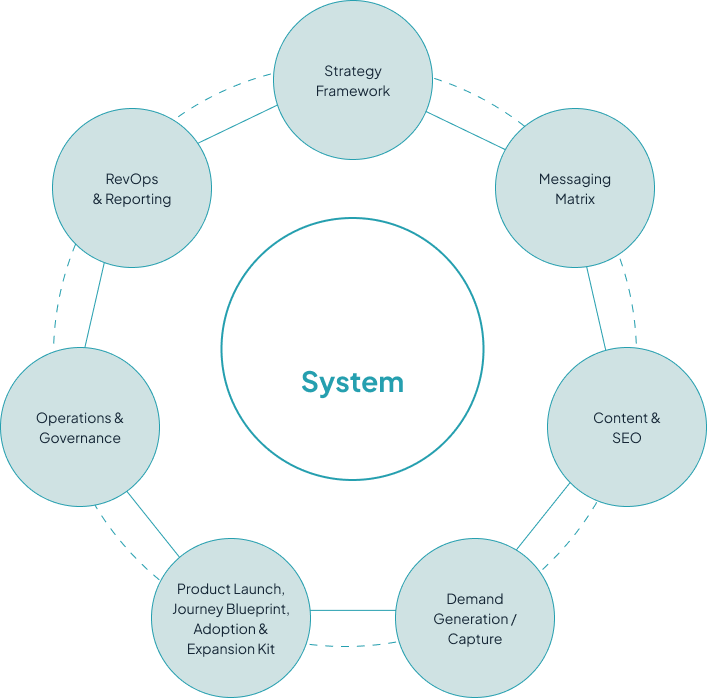
GTM Playbook Modules
Independent or connected deliverables. Adapted to the size, budget, and maturity of the team. Ready to execute from day one.
Go-to-Market Strategy
Market & competition: size, trends, 3–5 competitors and gaps
Differentiated proposition (RICE/ICE) with real use cases
GTM architecture (sales/product/channel) + key journeys & handoffs
See full checklist →
Market analysis: size, trends, and 3–5 key competitors
Value gaps and risks of commoditization
Prioritized segments and use cases (RICE/ICE)
Detailed ICP (signals, pains, jobs-to-be-done)
Differentiated positioning (map and unique value proposition)
Hybrid GTM model (sales-led / product-led / channel) with activation scenarios
Enriched customer journey: touchpoints, triggers, handoffs, micro-messages
KPIs by stage and granular budget per initiative with benchmarks
Narrative & Positioning
Value-based narrative with pains, proof, and differentiators
Messaging matrix by product, segment, stage, and channel
A/B tests of different variants with pilot campaigns on LinkedIn or Meta
See full checklist →
Narrative pillars and value proposition
Messaging by segment, product, stage, and channel
Proof points, evidence, and differentiators
Tone and usage guides for SDRs, demos, web, campaigns, and consultative sales
A/B test setup (3 variants) with tactical spend on LinkedIn/Meta
Result readout and next-test recommendations (customer validation)
Content Strategy
Structured content plan by funnel stage (TOFU, MOFY, BOFU)
Keyword research with intent-based clusters (outsourced)
On-page technical SEO roadmap with KPIs and optimization plan (outsourced)
See full checklist →
Research and clustering by intent (informational, consideration, decision)
Briefs and editorial calendar aligned with stages of the buyer journey
On-page optimisation (titles, internal linking, EEAT) and basic technical optimisation
Distribution plan (owned, earned, and paid) + key content updates
KPIs: Organic CTR, rankings, qualified traffic, and contribution to pipeline
Operating Plan & Governance
Quarterly calendar with campaigns, launches, and content
Roles, tools, and budget documented with clear owners
Monthly follow-up with OKRs, rituals, and automated alerts
See full checklist →
Quarterly calendar with campaigns, launches, and key dependencies
Clear RACI by block and handoff points between teams
Tool stack and operating budget
Quarterly OKRs + KPIs by funnel stage
Weekly/monthly rituals for follow-up
Automated alerts for deviations (e.g. Notion + Zapier)
Demand Generation Plan
Multichannel strategy: inbound, ABM, paid, events, and nurturing
Quarterly goals with documented milestones and key content
Leads → SQLs → Wins dashboard with integrated correction plans
See full checklist →
Campaigns aligned with the Message Matrix and the buyer journey
Multi-channel strategy with indicative budget (payment, inbound, ABM, events, nurturing)
Sequences per channel with quarterly milestones and key assets (cases, comparisons, nurturing content)
Corrective action plans for underperformance
Dashboard leads → SQLs → Wins (ej. en HubSpot) con criterios de éxito definidos
RevOps: Pipeline, Forecast & SLAs
Unified stages and handoff rules MKT → Sales → CS
Conversion cohorts and documented multichannel attribution
Weekly reporting on leakage, velocity, win rate, and forecast
See full checklist →
Stage definitions (MQL, SQL, SAL, Opportunity, Customer)
Handoff rules and SLAs across teams
Cohorts by channel, campaign, and segment
Attribution models (first touch, last touch, hybrid)
Pipeline health: leakage, velocity, win rate
Weekly reporting with alerts (drop ≥ X%) + monthly review vs. plan
Quarterly OKRs (CAC, LTV, ACV, NRR) and corrective actions
Product Launch Kit
Detailed plan for pre, launch, and post in 30 days
Campaigns, sequences, owners, and clear KPIs
Go/No-Go checklist integrated in your tools (Notion, Slack, etc.)
See full checklist →
Launch narrative and offer
Pre-launch strategy: goals, ICP, GTM, and pricing plan
Execution roadmap: day 0 + first 7/14/30 days with clear owners & KPIs
Sequences per channel and milestones
Owners, dependencies, and risks
Launch KPIs and Go/No-Go thresholds (automated)
Customer Journey Blueprint
End-to-end journey map: from awareness to expansion
Triggers, actions, and rewards using the Hook model
One-pager with North Star and stage-level metrics
See full checklist →
Stage definitions and goals by phase
Triggers/actions and owners per touchpoint
Progress signals and risks by stage
Friction heatmap (Looker Studio)
North Star Metric and supporting metrics
Experiment backlog by loop (activation, habit, retention)
Adoption & Retention
Onboarding flows designed to reduce time-to-first-value
Nurturing and in-app prompts that reinforce key habits
Expansion dashboards and RICE metrics directly in Slack
See full checklist →
Onboarding flows by segment and use case
Activation & habit metrics (DAU/MAU, stickiness)
Re-engagement campaigns and in-app prompts
Expansion and risk signals; upsell/cross-sell rules
RICE experiment templates with iteration cadence
NRR bot in Slack (Zapier + ChatGPT summaries)
Deployment Phases
Not every company needs the full system at once. You can start with the phase or module that solves your most urgent challenge, whether it’s sharpening narrative, fixing pipeline leaks, or improving retention. Each piece delivers measurable impact on its own, and together they build a lean, connected and scalable GTM system.
01
Foundations
GTM Strategy Framework + Messaging & Positioning + Content Strategy
02
Operations & Measurement
Operating Plan & Governance + Demand Generation + RevOps
03
Scale & Retention
Product Launch Kit + Customer Journey Blueprint + Adoption & Expansion