Why visibility now depends on how your brand shows up across Reddit, YouTube, and Wikipedia — not just Google.
Introduction: When SEO Outgrew Google
In my last article, I explained why topic depth beats keyword chasing in the AI era.
But depth alone isn’t enough—you also need to show up in the places where AI assistants actually look for answers. That’s the distribution side of the equation, and it’s changing fast.
For most of the last decade, SEO meant one thing: optimizing for Google. You researched keywords, wrote blog posts, earned backlinks, and hoped to rank higher in search results.
But in the AI era, Google is no longer the only search engine that shapes visibility.
AI SEO strategy now requires optimizing for the platforms large language models rely on — not just traditional search rankings.
1. What AI Agents Are Actually Reading
When someone asks ChatGPT, Gemini, or Perplexity a question, those AI systems don’t only pull from Google’s index.
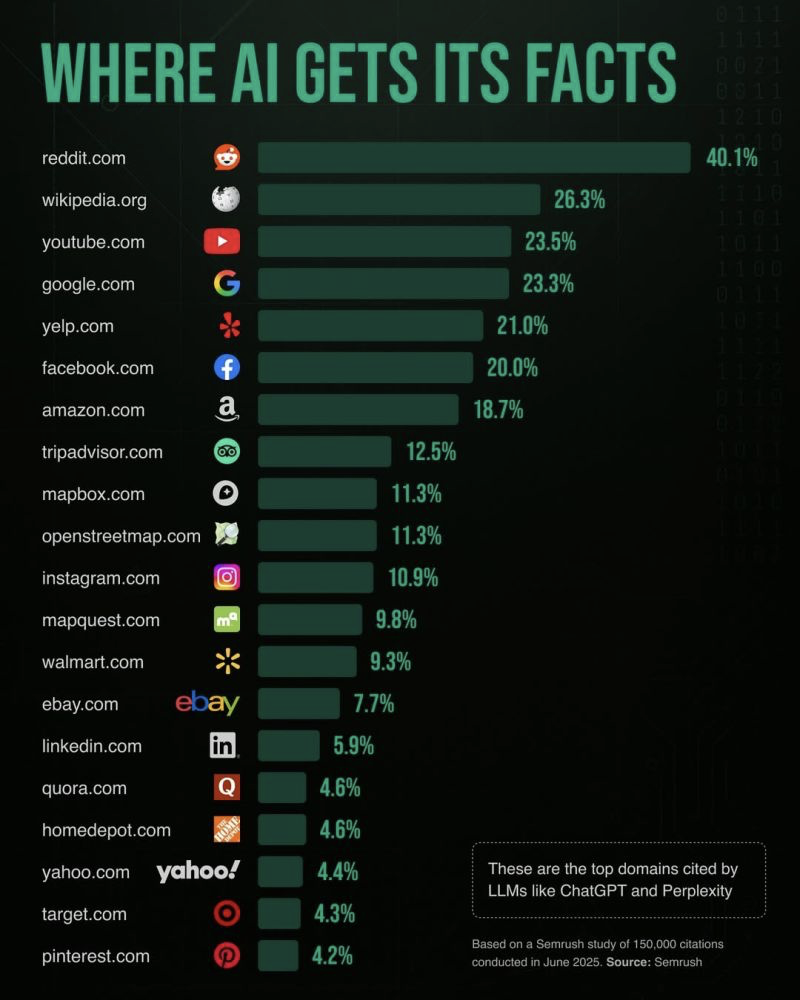
Recent analyses of AI outputs show a heavy reliance on platforms like Reddit (≈40%), Wikipedia (≈26%), and YouTube (≈24%)—with Google itself ranking no higher than fourth.
While exact figures vary by model and query, the trend is clear: AI agents diversify their sources far beyond traditional search indexes.
2. Why This Matters for B2B Visibility
Your buyers get answers in new places and new ways. SaaS founders or marketing leaders searching for “best PLG strategy” may not land on your blog through Google the way they once did. Increasingly, they turn to AI assistants, which deliver a huge user experience advantage by stitching together content from a Reddit thread, a YouTube explainer, a Wikipedia entry, and yes, sometimes even a top Google result.
And here’s the key: those answers only appear because the content on each platform has been shaped to succeed there. Each platform has its own rules:
- Reddit → credibility comes from authentic community participation. Spam or self-promotion gets downvoted fast.
- YouTube → success isn’t about keywords—it’s about retention. Thumbnails, storytelling, and watch time are the signals that count.
- Wikipedia → credibility depends on citations and neutrality, not marketing spin.
💡 Key takeaway: Influence now beats traffic. Even if AI summaries don’t send clicks back, shaping the source material means shaping perception.
Rand Fishkin calls this “influence over traffic.”
3. Don’t Abandon SEO — Evolve It
It’s tempting to think SEO is obsolete in this new landscape. That would be a mistake. Traditional SEO is still foundational—here’s why:
- Google remains a primary source. Even in AI rankings, Google accounts for about a quarter of the data pulled—and it still dominates human-led discovery.
- AI assistants often summarize SERPs. If you rank on Google, there’s a higher chance your content gets surfaced in AI answers as well.
- B2B buyers still click. Especially in high-stakes purchases, decision-makers dig deeper. Zero-click isn’t the whole picture.
And the numbers confirm it: search still drives more than 50% of digital revenue, compared to less than 5% from LLMs today. In other words, AI assistants are reshaping influence — but Google still monetizes intent. Smart GTM leaders design for both.
Why? Because search is a mature, scaled behavior with built-in monetization—and unlike LLMs, it still generates measurable clicks, traffic, and conversions. AI assistants shape perception, but search still drives the bulk of attributable revenue.
At the same time, search itself has expanded.
Buyers now “search” on:
- YouTube for explainers
- TikTok for quick takes
- Amazon for products
- AI assistants for synthesized summaries
The shift isn’t to abandon SEO — it’s to elevate it into a cross-platform discipline.
4. What This Means for B2B Marketing Teams
Most B2B marketing teams are still over-indexed on Google blogs and paid search. But if AI agents are pulling mostly from Reddit, YouTube, Wikipedia and other channels, then ignoring those platforms makes you invisible in AI-driven answers.
This demands a new mindset:
SEO is no longer just a channel — it’s your distribution strategy.
The goal is to ensure your brand appears wherever buyers and AI assistants are sourcing credible information.
5. Framework: The Platform-Native Influence Matrix
To operationalize this, think in terms of platforms and their native rules:
- Participate in relevant threads (e.g., r/SaaS, r/marketing).
- Share expertise, not pitches.
- Use a community manager to maintain credibility.
YouTube
- Publish explainers, product walk-throughs, or webinars.
- Focus on storytelling, visual clarity, and retention — not SEO tags.
Wikipedia
- Ensure your category, technology, and terms have accurate, cited pages.
- Build long-term credibility through verifiable neutrality.
Owned Content
- Whitepapers, benchmark reports, and blogs remain essential.
- Use them as inputs feeding into Reddit, Wikipedia, YouTube, and earned media — not as isolated assets. Their impact will grow.
Important: This cross-platform alignment should be documented inside a structured GTM Playbook — not handled ad hoc by channel owners.
6. The Critical Nuance: Choose the Right Platforms
This isn’t about chasing every new platform. It’s about prioritizing where your buyers are most influenced and where AI is most likely to pull from.
- If you’re a cybersecurity vendor, Reddit and Wikipedia may be key.
- If you’re selling to developers, Stack Overflow or GitHub discussions may matter more.
- If you’re in SaaS marketing, YouTube explainers and thought-leader podcasts might shape more opinions than blog posts.
By mapping this, you can direct GTM resources to the channels that maximize both influence and discoverability.
7. Other Signals That Feed AI Search
While Reddit, YouTube, Wikipedia, Google, and owned content form the priority stack for B2B visibility, two additional factors are worth keeping in mind:
Media Coverage
Mentions in outlets like TechCrunch, Forbes, Gartner, or industry publications indirectly boost visibility.
These sites are highly crawled; coverage often cascades into Wikipedia, Reddit, and backlinks — all core inputs for AI models.
Social and Review Platforms
AI can also pull from Facebook, Instagram, TripAdvisor, and review sites.
For consumer brands, ratings heavily shape what AI cites.
For B2B, the effect is smaller — but credibility across every footprint still matters.
💡 Insight: These shouldn’t distract from your B2B priorities. But they highlight a bigger truth: omnichannel presence now matters more than ever.
8. Bottom Line: From Search-First → Distribution-First
Winning visibility in the AI era means mapping influence across multiple platforms, not just optimizing for one search box.
That means thinking beyond Google rankings alone:
- Reddit → authenticity through community.
- YouTube → engagement through storytelling.
- Wikipedia → credibility through neutrality and citations.
- Google/SEO → still critical for authority and visibility.
- Owned content → feeding multiple platforms, not living in isolation.
The new mindset is:
“Where are both my buyers and AI assistants sourcing answers — and how do I ensure my expertise lives there?”
Companies that master this multichannel SEO strategy don’t just chase clicks — they shape the narrative long before buyers ever land on their site.
That’s the new game: influence, not just traffic.