A step-by-step playbook to replace SDR improvisation with signal-driven execution — from first touch to closed won. Here’s how to build it.
Most B2B SaaS teams don’t fail because of poor execution.
They fail because execution is disconnected from context.
When pipeline slows down, the reaction is almost always the same:
- write better scripts
- add more sequences
- push SDRs to “be more proactive”
It feels like action.
But it rarely fixes the real problem.
What breaks predictability is not effort.
It’s the absence of a signal-based GTM system that connects behavior, context, message, and action across the funnel.
This article explains:
- why scripts stop scaling
- what a signal-based GTM system really is
- how to implement it step by step (with real tools)
- and how to extend it beyond emails into qualification, calls, and deal progression
1. Why Sales Scripts Stop Working as You Scale
Scripts assume one dangerous thing:
that message quality matters more than timing and context.
That assumption used to work.
It doesn’t anymore.
Today:
- buyers start evaluating before they talk to sales
- intent shows up in behavior, not in forms
- relevance beats personalization every time
Most inbound “leads” arrive with:
- a name
- an email
- maybe a company
But the why is missing.
The intent exists — it’s just:
- buried in web behavior
- spread across tools
- never interpreted for the rep
So when an SDR engages, they’re not just selling.
They’re forced to do three jobs at once:
- reconstruct why the lead exists in the first place
- decide what to say without knowing what triggered interest
- decide what to do next while the conversation is already happening
That’s not empowerment.
That’s cognitive overload.
And overloaded teams don’t scale — they improvise.
2. From Scripts to Signals: The Shift High-Performing GTM Teams Make
A signal is any observable behavior that increases the probability that an account is entering a buying window.
Some are explicit:
- demo requests
- pricing page visits
But the most valuable ones are implicit:
- repeated visits to product or integration pages
- a new VP Sales or RevOps joining
- funding rounds or hiring spikes
- LinkedIn posts expressing a clear pain
Some companies already see these signals.
Very few have a system to integrate them and act on them coherently.
That missing layer is what separates busy teams from predictable ones.
3. The Core System: Signal → Message → Action
Most GTM setups break because everything is fragmented:
- signals live in tools
- messaging lives in docs
- execution lives in people’s heads
What you need is a decision layer in between.
This logic should live inside a documented GTM system — not in scattered docs or individual inboxes.
The Signal-to-Message Matrix (core of the system):
This matrix removes improvisation and makes execution scalable.
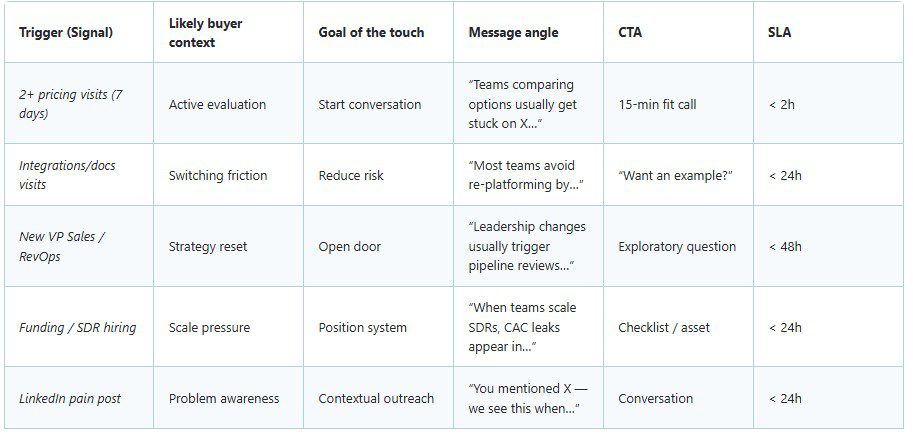
The rule is simple:
SDRs don’t invent messages. They select scenarios.
They personalize the final 20%. Everything else is system-driven.
4. The Minimal Architecture for a Signal-Based GTM System
Signals → Enrich → Score → Route + SLA → Draft Message → SDR Send → CRM Log → Learn
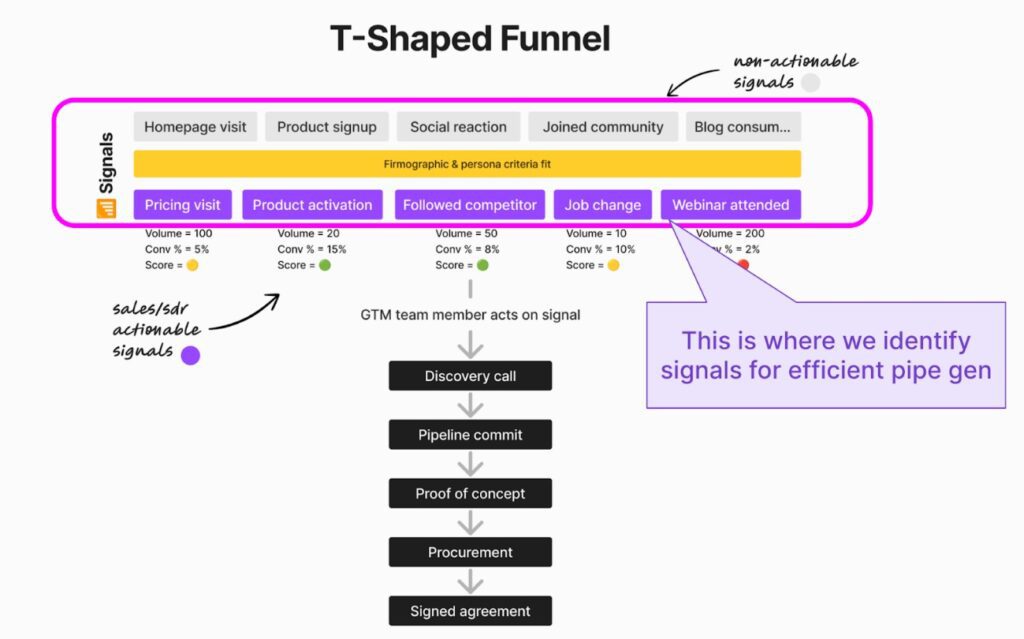
Let’s make this painfully concrete.
4.1. Signal Capture
“Something happened. This account might care now.”
What it is: Detecting buyer behavior without asking for forms.
Typical signals
- website behavior (pricing, product, docs)
- job changes, funding, hiring
- public social signals
Tools
- Website signals: HubSpot, Leadfeeder
- Firmographic & job changes: Clay
- Social signals: Sales Navigator (manual or assisted)
Output
A raw signal event stored in the system
(e.g. “Company X visited Y at time Z”).
At this stage:
- no priority is assigned
- no owner is defined
- no selling happens
The signal is “observed, not yet interpreted”.
The system is preparing the decision.
4.2. Enrichment & Scoring
“Is this event worth SDR attention?”
What it is: adding context and deciding priority.
This is where raw signals are interpreted and prioritized by the system, not by individual reps.
Enrichment
- company size
- industry
- tech stack
- ICP fit
Tools
- Clay (best single tool)
- Apollo (alternative)
Very simple scoring model
| Rule | Score |
| ICP match | +3 |
| Pricing visit | +3 |
| Integrations visit | +2 |
| Funding / hiring | +2 |
| Non-ICP | −5 |
Result:
- P0 (hot)
- P1 (warm)
- P2 (cold)
Red, yellow, green. Nothing fancy.
4.3. Routing + SLA
“Who acts, and how fast?”
Once a signal has been enriched and scored, the system’s job is no longer interpretation.
It’s orchestration.
At this stage, the question is simple:
who should act on this signal, and within what timeframe?
This decision is made by rules — not by individual reps.
Routing rules (example)
| Priority | Owner | SLA |
| P0 (strong signal) | SDR | 2 hours |
| P1 (moderate signal) | SDR | 24 hours |
| P2 (weak or ambiguous signal) | Marketing | No SDR |
Tools
- Salesforce or HubSpot workflows
Output
For P0 and P1 signals, the system automatically creates a task inside the tool the SDR already works in (CRM or sales engagement tool).
Example of what the SDR sees:
🔥 P0 account
Trigger: Pricing page visit
Action: Reach out
SLA: 2 hours
The task includes:
- the triggering signal
- the assigned priority
- the expected response time
No discussion.
No inbox archaeology.
What happens when signals are weak
When signals are weak or ambiguous, they do not go to sales.
Instead, they are routed to marketing-led nurture.
The original signal is preserved and used to:
- segment the lead
- personalize nurture content
- inform future scoring decisions
If intent strengthens later, the account re-enters the sales path with full historical context attached.
This is how a signal-based system supports sales-led and hybrid GTM models without wasting SDR time.
5. Message Generation: No Blank Screens
This is where most GTM systems fail.
They detect signals.
They score and route them.
And then the rep still has to start from a blank screen.
The rule: never let a rep start from zero.
How signals map to a message:
Signals don’t map directly to copy.
They map to buyer context, which maps to a message angle.
This logic lives in the Signal-to-Message Matrix, defined once and reused consistently.
| Signal | Interpreted context | Message angle |
| Pricing visit | Active comparison | Clarify evaluation criteria |
| Integration docs | Switching friction | Reduce perceived risk |
| New RevOps leader | Process reset | System-level framing |
| Funding / hiring | Scale pressure | Execution gaps |
How drafts are created:
Once an angle is selected, AI assembles a first draft using:
- the signal
- the chosen angle
- basic account context
- approved language from the knowledge base
The goal is not creativity.
It’s speed and consistency.
For instance, when a prospect has repeatedly visited your pricing or comparison pages, it’s a clear intent signal. The SDR gets notified — and that’s when this type of message gets triggered, ready for them to review and send.
Example draft:
“Not sure if you’re actively comparing options yet.
But at this stage, most teams start evaluating alternatives because [reason].
Happy to share how others approach this — no full demo required.”
Where SDR judgment fits:
SDRs don’t lose autonomy — they lose busywork.
They:
- adjust tone
- add a relevant detail
- personalize the final 10–20%
The system removes low-value decisions so reps can focus on quality interactions, not message construction.
Where this appears:
The draft appears inside the existing workflow:
- CRM task
- or sales engagement inbox
No extra tools.
No prompt writing.
No blank screens.
Key principle:
The system does the heavy lifting.
The rep brings judgment and human nuance.
6. Execution: Clarity Over Guesswork
This is where all upstream decisions finally turn into action.
What the SDR actually sees
- why this account matters
- what happened
- recommended angle
- draft message
- suggested CTA
Tools
- Outreach
- Salesloft
- HubSpot Sequences
Key rule:
If execution requires too much thinking, the system failed.
7. CRM Logging & Feedback Loop
Everything logs automatically:
- activity
- signal type
- stage
This later lets you answer:
“Which signals actually create pipeline — and which ones marketing should double down on?”
8. Stage-Aware Messaging: Where Revenue Is Won
This is the part most GTM systems ignore — and where money is made.
Signals don’t stop after the first email.
Deals progress through stages, and messaging — across emails, calls, and follow-ups — must evolve with them..
The problem
After initial engagement:
- qualification becomes inconsistent
- calls depend on personal style
- follow-up emails vary wildly
The system breaks exactly when stakes are highest.
The solution: stage-aware execution
8.1. Message & Call Repository
Not just templates — guided execution across stages and channels.
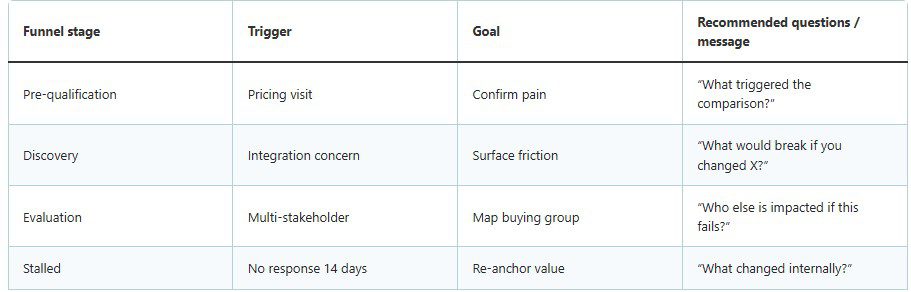
This repository lives in Notion / Confluence and is governed like a product, not a document.
8.2. Custom GPTs (only after clarity)
This is where AI actually helps — after the messaging matrix and knowledge base exist.
The GPT does not “chat”.
It Works from structured input:
- account profile
- funnel stage
- detected signals
- previous interactions
Output
- call agenda
- discovery questions
- follow-up email draft
- risk signals to watch
This:
- reduces cognitive load
- standardizes quality
- preserves human judgment
This is typically designed and implemented after the system foundations are in place.
8.3. Execution embedded in the workflow
Critical rule:
If reps have to “go ask the GPT”, it won’t scale.
Instead:
- email or call task opens → guidance auto-attached
- pre- and post-meeting emails → draft suggested
- stage change → relevant playbook loaded
AI is invisible.
Execution is faster.
Quality is consistent.
9. What to Measure in a Signal-Based GTM Model
Forget:
- emails sent
- activities logged
Measure instead:
- % of P0/P1 accounts touched within SLA
- meeting rate by signal type
- signal-to-opportunity time
- pipeline velocity per trigger
These metrics tell you whether the system works — not just whether people are busy.
10. Why a Signal-Based GTM System Reduces CAC
Because:
- SDR time focuses on real intent
- messaging matches buyer context
- speed beats competitors
Predictability doesn’t come from effort.
It comes from orchestration.
11. Why Systems Beat Hero Sales Reps
Good reps matter.
But hero-driven GTM never scales.
Predictable growth comes from:
- clear signals
- defined message logic
- stage-aware execution
You don’t need more scripts.
You need a signal-based GTM system that makes the right action obvious at every stage.
Final CTA
If your pipeline depends too much on individual judgment, you don’t have a GTM system yet.
I help B2B SaaS teams design and implement signal-driven GTM systems — including the messaging matrix, the execution model, and custom GPTs that actually reduce CAC and restore predictability.
👉 If you want a structured diagnosis, my GTM Audit (4–8 weeks) identifies where your system breaks and delivers a clear 90-day execution plan.