This article is written for SaaS leaders operating under capital efficiency pressure — particularly PE-backed and post-Series A–C companies where revenue quality now directly impacts valuation.
1. Why Growth-at-All-Costs No Longer Works for PE-Backed SaaS
Over the last few years, B2B SaaS growth economics have tightened. Public market multiples have compressed. Private valuations in M&A processes increasingly scrutinize retention quality, payback periods, and capital efficiency. Growth is no longer rewarded independent of its economics.
In many PE-backed and post-Series B SaaS companies today, the pressure shows up in measurable ways:
- CAC payback stretching beyond 18 months
- Net Revenue Retention drifting below 105–110%
- Sales efficiency ratios compressing
- Pipeline growth masking weak activation and expansion mechanics
These are not marketing inefficiencies.
They are lifecycle design signals.
At the same time, market saturation has increased. In many verticals, customers now evaluate multiple overlapping SaaS providers. Competition is no longer just about features, but about economic durability.
Compounding this dynamic, the rapid rise of AI-native SaaS vendors is accelerating competitive density across categories. Barriers to product development have lowered. New entrants can launch faster, iterate faster, and compete aggressively on positioning and pricing.
In this environment, acquisition becomes structurally more expensive. Attention fragments. Perceived differentiation decays faster. Retention quality increasingly determines valuation.
This marks a structural shift from the previous phase of SaaS expansion, when capital was abundant, funnels were assumed to be linear, and growth was treated as a volume equation:
More spend → more leads → more pipeline → more ARR.
When acquisition economics were favorable, the system tolerated inefficiency. Activation gaps and retention softness did not immediately derail growth because incremental demand could temporarily mask structural leakage. Fragmented RevOps could survive as long as pipeline expansion outpaced friction elsewhere in the lifecycle.
That tolerance is far thinner today.
Lifecycle inefficiencies that were once absorbed by acquisition are now visible — and financially material.
What many teams are experiencing is not a channel issue.
It is a lifecycle design issue.
To understand why this happens, we need to examine how most GTM models are structurally designed.
2. The Structural Problem: Most GTM Models End at Closed-Won
Most GTM organizations still operate with a model that psychologically ends at Closed-Won. In other words, they treat the funnel as linear.
Marketing optimizes lead flow.
Sales optimizes conversion.
Customer Success inherits the account.
Incentives diverge. Metrics fragment. The system breaks.
The problem is not effort. It is structure.
The moment Closed-Won becomes a departmental handoff instead of a capital midpoint, economic leakage begins.
The traditional funnel assumes one-directional movement: if we put more in at the top, we will get more out at the bottom.
More tactics.
More channels.
More budget.
More, more, more.
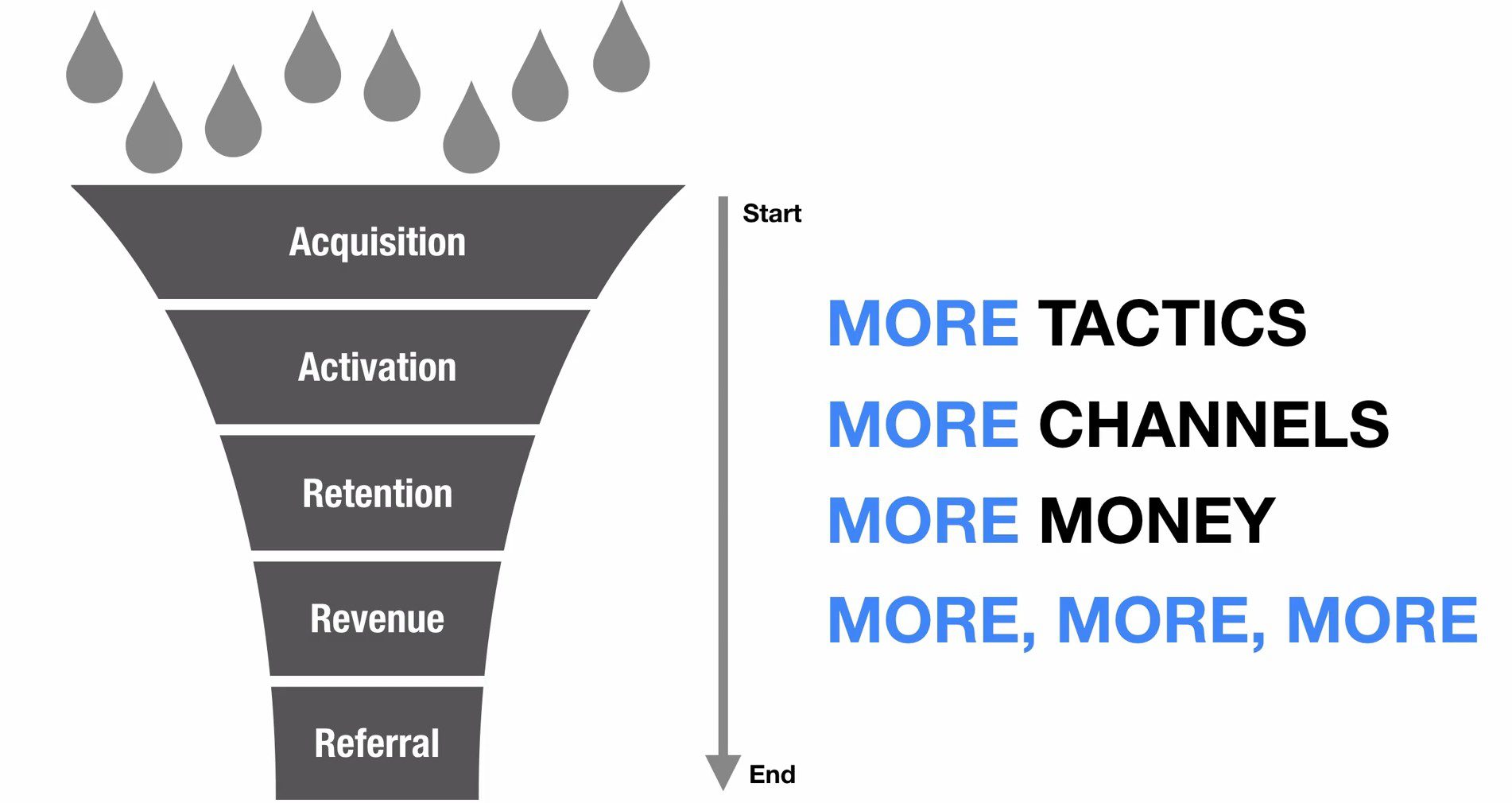
A linear GTM model with no structural reinvestment loop
What this model ignores is reinvestment.
Revenue economics do not reset at conversion. They compound — positively or negatively — across activation, retention, and expansion. If time-to-value is slow, expansion mechanics are weak, or churn signals go unnoticed, acquisition must compensate.
That compensation shows up as:
- Rising CAC
- Extended payback periods
- Volatile pipeline
- EBITDA pressure
The funnel produces linear growth.
The current market demands compounding growth.
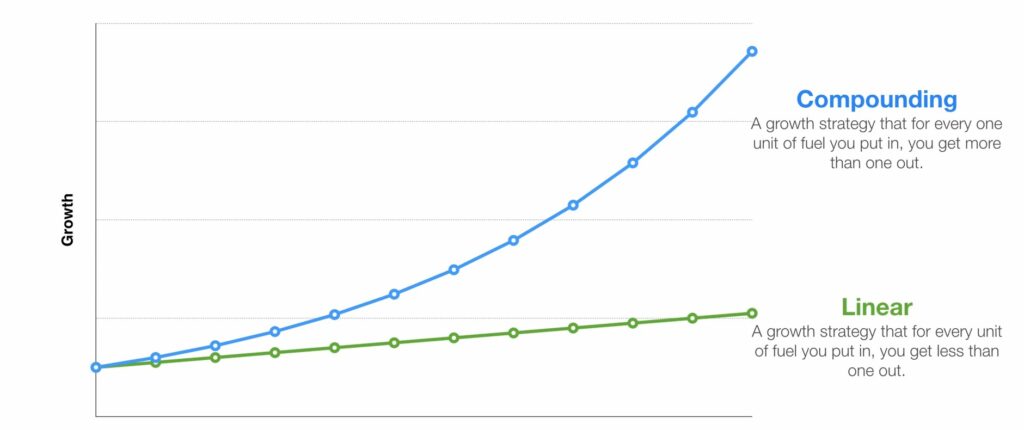
And that is where the Bowtie model becomes strategically relevant.
3. The Bowtie Funnel: From Acquisition to Expansion
The Bowtie model, developed by Winning by Design, provides a structurally accurate lens for understanding revenue.
The Revenue Architecture principles articulated by Jacco van der Kooij clarify what many GTM organizations overlook: acquisition, activation, retention, and expansion are interconnected economic mechanisms — not departmental handoffs.
It reframes growth not as a funnel that ends at Closed-Won, but as a lifecycle:
Acquire → Convert → Commit → Onboard → Retain → Expand
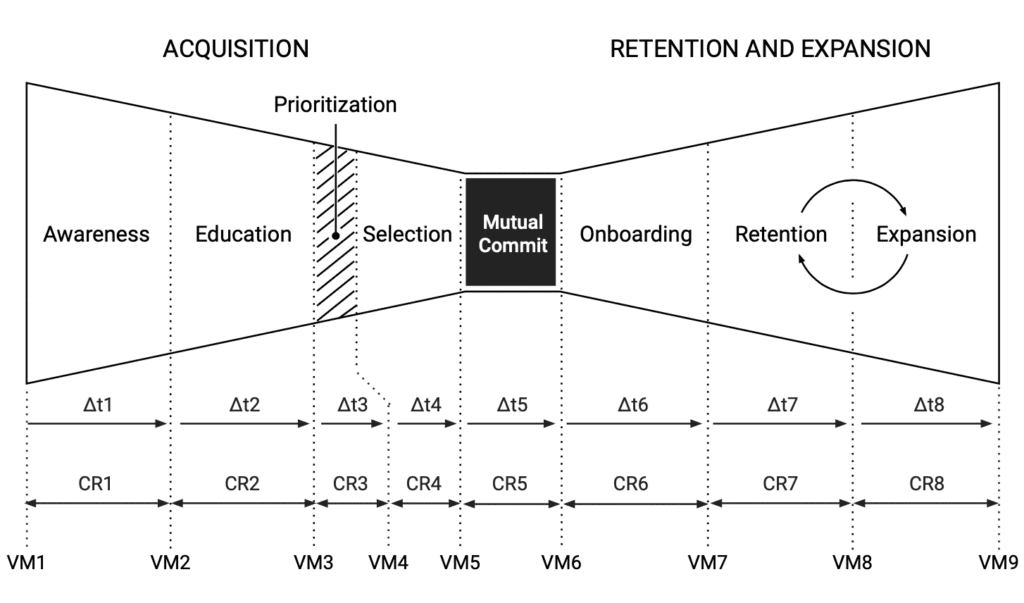
Source: Revenue Architecture Textbook (Jacco van der Kooij)
Closed-Won is not the end of the journey. It is the midpoint.
The left side converts market attention into revenue.
The right side determines whether that revenue compounds or erodes.
This distinction matters because revenue quality is determined after commitment, not before it. Activation speed, retention strength, and expansion mechanics directly influence CAC efficiency, payback compression, and ultimately enterprise value.
The Bowtie is powerful because it aligns Marketing, Sales, and Customer Success around one lifecycle instead of disconnected silos, incentives and local optimizations.
However, many organizations stop at conceptual adoption. They define stages and align terminology, but the lifecycle remains under-instrumented and weakly connected to economic outcomes.
Many teams adopt Bowtie terminology.
Few operate it as a capital allocation system.
Tracking stage conversion is common.
Tracking stage conversion relative to retention durability and expansion yield is rare.
The difference is not vocabulary. It is economic instrumentation.
When growth slows, the question shifts. It is no longer simply, “Do we need more leads?” It becomes structural:
• Is ICP selection aligned with long-term retention economics?
• Is activation delaying time-to-value?
• Are we reinforcing value post-sale in measurable ways?
• Do expansion triggers exist structurally, or are they opportunistic?
A lifecycle lens exposes constraints that a linear funnel obscures.
4. Turning the GTM Model into an Operating System
While the Bowtie provides the structural backbone, a model alone does not change performance. It must be instrumented, connected, and reviewed as a living system.
This is where most organizations stop: they adopt the lifecycle conceptually, but they do not operate it economically.
To move from model to operating system, two additional layers are required:
• A RevOps & Insights layer
• An AI Acceleration layer
In practical terms, this is the difference between retrospective reporting and forward-looking capital control.
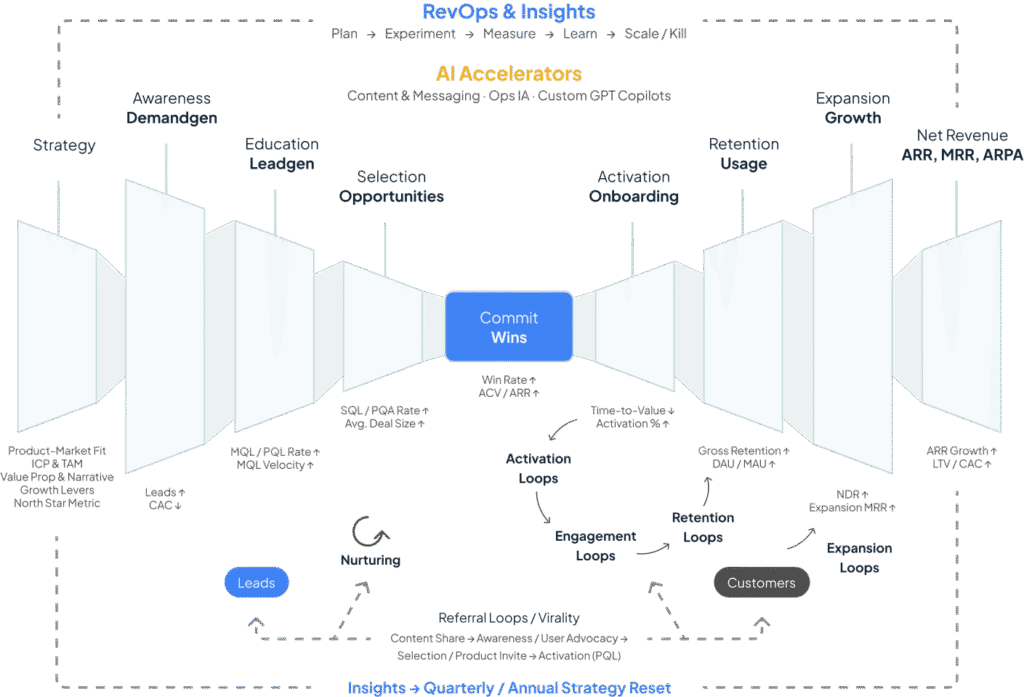
A Capital Allocation–Optimized Evolution of the Bowtie Revenue Model
RevOps & Insights Layer: Making the Lifecycle Measurable and Correctable
Across the full lifecycle, the objective is not reporting. It is early constraint detection.
Plan → Experiment → Measure → Learn → Scale or Kill
In practice, this means:
- Unifying marketing, CRM, and product data into a single lifecycle view.
- Aligning stage definitions so conversion metrics reflect economic reality, not internal optimism.
- Connecting CAC, activation speed, retention behavior, and expansion patterns into one analytical model.
- Reviewing lifecycle performance on a weekly operating cadence rather than relying on monthly/quarterly retrospectives.
Without this layer, leadership sees dashboards.
With it, leadership sees capital friction while it is still correctable.
When activation slows by two weeks, the system surfaces it.
When churn risk patterns shift, the signal appears before renewal.
When expansion correlates with specific behaviors, those triggers become testable.
The gain is not visibility alone.
It is earlier capital intervention.
AI Acceleration Layer: Increasing Throughput Where Structure Exists
AI becomes economically meaningful only after lifecycle mechanics are instrumented and validated.
Used correctly, it reduces detection latency and accelerates execution.
In operational terms, this can include:
- Contextual deal scoring trained on historical conversion patterns
- Early churn risk detection based on behavioral deviation
- Automated classification of ICP quality beyond surface demographics
- Insight synthesis across CRM, product, and marketing data
- Defined GPT workflows embedded in sales qualification, onboarding, and expansion identification
The objective is not more automation.
It is faster decision cycles and scalable execution without proportional increases in headcount or spend.
Sequence matters:
Design the lifecycle.
Instrument it.
Then accelerate it.
AI amplifies what already works. It does not fix structural flaws.
Why This Is a Capital Allocation–Governed Evolution of the Bowtie Model
The Bowtie funnel connects acquisition and expansion across the lifecycle.
Revenue Architecture already instruments that lifecycle against economic reality — CAC efficiency, activation velocity, retention durability, expansion yield.
What this model adds is governance and acceleration.
Operationally, this changes how decisions are made week to week.
The RevOps layer creates continuous lifecycle monitoring through unified CRM, product, and billing data. This shifts the organization from retrospective reporting to early constraint detection — activation delays, CAC drift, retention risk, expansion gaps surface while they are still correctable.
The AI layer builds on that clarity. Once mechanics are validated, AI reduces detection latency further and increases throughput — prioritizing high-LTV opportunities, flagging churn risk before renewal cycles, surfacing expansion signals automatically, and triggering defined workflows.
Together, the two layers create:
• Continuous monitoring
• Earlier detection
• Faster decision cycles
• Greater throughput per unit of capital
The result is not more activity.
It is more precise capital compounding across the lifecycle.
But governance and acceleration alone do not create compounding. They only make it possible.
Compounding requires deliberate loop design.
5. Designing Compounding Revenue Loops
Funnels are linear. Growth dynamics are not.
At this point, the lifecycle is visible and governable. Loops determine whether it compounds.
Underneath the lifecycle, reinforcing mechanisms drive long-term efficiency.
While the Bowtie structures the revenue journey, and governance and acceleration allow early detection and execution, loops determine whether performance merely stabilizes — or structurally compounds over time.
Compounding does not happen at the level of isolated stages. It happens through reinforcing mechanisms embedded across the lifecycle.
Activation influences retention.
Retention shapes expansion.
Expansion insights refine acquisition.
The lifecycle is not a sequence. It is a system of economic reinforcement.
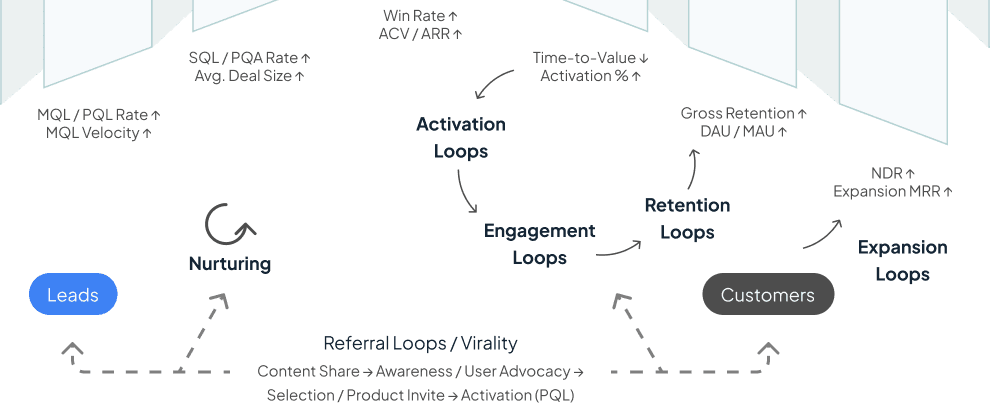
Compounding revenue loops reinforce value creation across the lifecycle and feed economic signals back into acquisition.
These loops are not designed for volume acceleration. They are designed for economic reinforcement.
Pre-sale loops reinforce education, qualification, and intent formation.
Post-sale loops strengthen activation, deepen engagement, and expansion momentum.
A pre-sale loop may operate as follows:
Segmented ICP hypothesis →
Acquisition deployed →
Cohort retention and expansion analyzed at 6–9 months →
High-LTV segment identified →
Low-retention segment deprioritized →
Budget reallocated toward durable revenue →
CAC efficiency and LTV/CAC expand structurally.
A post-sale loop operates differently:
Defined activation milestones instrumented (RevOps layer) →
Accounts reaching value threshold identified →
Expansion readiness triggered proactively (AI acceleration layer) →
Cross-sell / upsell executed before renewal pressure →
NRR increases predictably →
Expansion patterns inform ICP prioritization →
Revenue durability improves.
When these loops are deliberately designed and instrumented, growth becomes less volatile because value reinforcement offsets acquisition pressure.
Without loops, acquisition must continuously compensate for downstream friction.
In a capital-constrained environment, compounding matters more than volume.
6. The Architectural Outcome
When the Bowtie is treated as the structural backbone — and combined with disciplined RevOps instrumentation and selective AI acceleration — the system begins to behave differently.
Revenue loops become observable, measurable, and scalable.
RevOps makes them visible across the lifecycle. AI increases the speed and precision with which they operate. Compounding stops being accidental and becomes intentional.
Without lifecycle governance:
- CAC rises without visible cause
- Expansion remains opportunistic rather than designed
- Customer Success fights churn at renewal instead of reinforcing value early
- Marketing scales segments with hidden retention risk
- Pipeline growth masks downstream friction
In this environment, acquisition compensates for structural leakage. Growth expands, but yield erodes.
With governance in place:
- CAC connects visibly to retention quality
- Payback reflects activation performance
- Expansion becomes systematic rather than reactive
- Pipeline volatility decreases as value reinforcement strengthens
- Capital allocation decisions reflect lifecycle ROI, not volume metrics
The objective is not higher output.
It is higher yield.
Lifecycle visibility connects the right side of the Bowtie back to the left.
Retention and expansion patterns begin to inform acquisition strategy. ICP prioritization becomes economically filtered. Channel decisions reflect lifetime value, not just cost per lead.
In this model, the right side does not compensate for the left.
It optimizes it.
Campaigns create motion.
Architecture creates scale.
7. What This Means for GTM Leaders
When evaluating GTM performance, the most important questions are structural:
- How long does it take new customers to reach meaningful value?
- Where does conversion slow across the lifecycle?
- What percentage of expansion is proactive versus reactive?
- Which signals precede churn by one or two quarters?
- What is the true cost per opportunity — not just cost per lead?
These are not campaign questions.
They are system questions.
System questions determine capital efficiency.
8. Closing
Acquisition can buy growth temporarily.
Lifecycle design determines whether growth merely expands — or structurally compounds.
The Bowtie provides the structural lens.
RevOps makes it measurable.
AI increases throughput where economics justify it.
Loops determine whether results scale.
The discipline is not more activity.
It is architectural clarity.
Systems beat heroics.
In the current capital environment, GTM maturity is not defined by how much pipeline you generate — but by how precisely revenue compounds.
If you’re exploring this shift from different angles, you may also want to read:
• AI Ate Your Funnel
• SEO Reloaded: Winning Mind-Share in an AI-First World